Episode 154 | May 28, 2026 | 17:18
Every business decision you face as a financial coach has three stakeholders: You, your client, and your business. Most coaches only think about one or two of them when they’re deciding, and that’s usually why the decisions feel harder than they need to be.
I want to walk you through the framework I use for every business decision I make. I call it the Three Lens Framework, and once you see how it works, you’ll start using it in places that have nothing to do with running a coaching practice. Pricing, hiring, what to say yes to, what to say no to, even how to handle a session that’s gone sideways. The framework gives you a way to think through any of it without freezing, guessing, or copying someone whose business looks nothing like yours.
Key Takeaways
| Business decisions feel hard not because the decisions are complicated, but because you don’t have a consistent way of making them. Most coaches freeze, guess, or copy someone else. | |
| The Three Lens Framework asks you to look at every decision through three perspectives: what you need, what your client needs, and what your business needs. | |
| The most commonly ignored lens is the first one: You. Coaches build businesses that work for everyone else and burn out within two years because they never asked what they needed. | |
| The best answer to any business decision lives in the center where all three lenses overlap. That center point is always there, but sometimes it takes patience and sharper questions to find it. | |
| There are no universal rules in building a coaching business. There are only decisions you make, and this framework helps you make them from a place of confidence. | |
| The real example (whether to list prices on your website) shows how different coaches arrive at different answers using the same framework, because their practices, clients, and needs are different. | |
| Writing down your answers for each lens makes the overlap visible. Don’t skip this step. |
I see the same thing happen with a lot of coaches, both new and experienced: You face a business decision and you freeze. Or you guess. Or you ask five different people for advice, get five different answers, and end up more confused than when you started.
You face a business decision, and you freeze. Or you guess. Or you ask five different people for advice and get five different answers and then you’re more confused than when you started.
The decisions themselves are usually pretty simple ones. Should I charge $100 an hour or $150? Should I list my prices on my website? Should I do free consultations or paid discovery calls? Should I post on Instagram or focus on referrals? Should I niche down or stay generalist?
These are good questions, and they tend to feel hard for the same reason: there’s no framework underneath them, so each decision feels like starting from scratch.
The Builder is a free course that walks through eight foundational business decisions using this framework. Get access here. →
Without a framework, most coaches default to one of three patterns. Some freeze and keep researching without ever making a call. Some guess and pick whatever sounds right and hope it works out. And some copy another coach’s approach, even when that coach’s business looks nothing like theirs. Each pattern lands in the same place: A business that feels like it was designed by committee, with a little bit of this person’s advice and a little bit of that person’s strategy, and none of it quite fitting together.
The Three Lens Framework
The framework is based on a simple observation. Every business decision has three stakeholders.
There’s you, the person doing this work. There’s your client, the human sitting across from you. And there’s your business, the entity that needs to function and grow so you can keep doing this work.
Most coaches only think about one or two of these when they’re making a decision. They think about what’s best for the client, but they forget that they also need to earn a living. Or they think about what’s best for the business, but they forget to ask whether the answer actually serves the person in front of them. And often, the one that gets ignored entirely is the first one, which is the coach themselves.
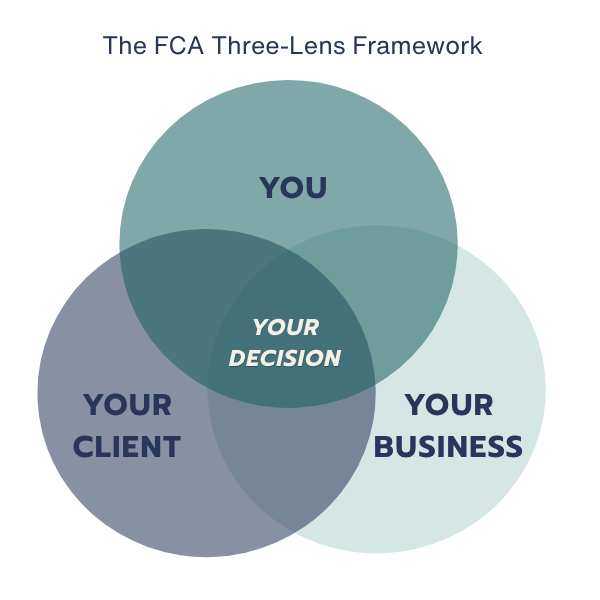
The framework asks you to look at every decision through all three lenses before you commit to an answer.
Lens 1: You
The first question to ask is what you need. What feels right to you? What energizes you versus what drains you? What kind of practice fits the life you actually want to live?
I can speak personally about this lens. A couple of years ago, I was starting to feel stuck in my business. Nothing was wrong from the outside. Business was solid, and clients were getting results. But on the inside, I realized I had built programs that were designed more for my team than for me.
I love one-on-one work, and yet all my new clients were going to my coaches. I love small groups with dynamic conversations where we really get into things, and I had built large group programs and masterminds instead. I like offers where what I say I’ll do for you is crystal clear, with a tangible outcome we can both point to and say, “We’ve done it.” My programs were built to deliver a variety of different results, with continuous renewal and expanding scope.
If you design a business that’s great for clients but terrible for you, it won’t last. And you won’t be good at it because you’ll resent it.
I had replaced what was best for me with what was best for the coaches on my team. That’s not a reflection on them. I wanted to do that. I cared about them. But when you ignore this first lens, it doesn’t take long to feel it: The stuckness, the lack of energy, the lack of creativity or drive, the frustration of showing up in a way that isn’t best for you.
Your energy and your mind are part of every decision you make. Treat them that way.
Lens 2: Your Client
The second question is what your client needs. What are they experiencing? What would serve them best in this specific decision?
Your coaching brain is already trained to think about other people’s needs. That’s part of what drew you to this work. The trick is bringing that same curiosity to your business decisions, not just your sessions.
A lot of business choices get made based on what other coaches are doing rather than what your specific clients actually need. The lens isn’t asking “what do clients in general want?” It’s asking what the people you actually serve need from you on this specific question.
Lens 3: Your Business
The third question is what your business needs to function, to be sustainable, and to grow.
Your business is its own entity with its own needs. It needs revenue, systems, and to be positioned in a way that attracts the right people. Sometimes what’s best for you personally and what’s best for the business are different things, and that tension is worth noticing rather than glossing over.
For example: Maybe you’d prefer to take five clients at a time and have a lot of spaciousness in your schedule. But your business needs 10 clients to be financially sustainable until you raise your prices or get better at your sales conversations. That’s a real tension, and it’s the kind of thing the third lens helps you see clearly.
Finding the center
You. Your client. Your business. Three lenses. The best answer lives in the center where all three overlap.
I believe the win-win-win scenario always exists. The center point is always there. But sometimes it isn’t obvious, and sometimes the first answer you come up with satisfies two of the three lenses and leaves the third one waving its hand. The temptation in that moment is to go with it. Good enough, right?
There are no rules you must follow in building your coaching business. There are only decisions you must make.
What I’ve found, though, is that the more patience I give a decision, the more I sit with it or research it or ask around, the more I find that center point. The answer that works for everyone. When you can see all three lenses clearly, you start asking better questions. Instead of “what should I do here,” the question becomes “what’s an approach that gives me X and serves my client with Y without creating Z?” That’s a targeted question, and it leads to targeted answers.
The solution that satisfies all three lenses is there. You just have to be willing to look for it.
A real example: should you list prices on your website?
Let me show you how this works in practice with a question I get all the time. “Should I list my prices on my website?” People want a rule. Yes or no.
There’s no universal right answer to this one. Some coaches list prices, some don’t, and both can work. Watch what happens when you run the question through the framework.
Through Lens 1 (you): how do you feel about it? Some coaches love listing prices because it feels transparent and saves them from awkward conversations. Other coaches feel like listing prices reduces their work to a number before the client understands the value, and they want the chance to build trust before price comes up. A third group could genuinely go either way and doesn’t have a strong preference. None of these is wrong, but how you feel matters because you’re the one who has to stand behind the choice.
Through Lens 2 (your client): what does your specific client need? In my practice, my clients are busy professionals already experiencing decision fatigue. When they land on my website, the last thing they need is another complicated decision, so I put one clear next step in front of them. About 85% of my clients come from referrals, and most of the time they don’t even visit my website before we connect. For my clients, a pricing page with multiple options would serve them less well than one clear action. Your clients might be different. If they’re comparison-shopping between coaches, they might need pricing upfront to feel comfortable reaching out at all.
Through Lens 3 (your business): what does your business need? If listing prices pre-qualifies leads and saves you time on calls with people who can’t afford your services, that serves the business well. You’re talking to better-fit people, and if you’re near capacity on your client load, that filter becomes essential. If not listing prices means more conversations where you can demonstrate value before price comes up, that might serve the business better. You’re building relationships rather than filtering people out. The right answer depends on your model.
The answer that works for everyone… it’s there. You just have to be willing to look for it.
The answer I arrived at is different from yours, and it should be. My practice is different, my clients are different, and my needs are different. I am not trying to create a bunch of mini-Kelsas. The framework has been instrumental in my own life and business, and when you use it, it will probably point you in a direction that’s different from where I landed. There are a lot of right ways to build a coaching business, with money, with relationships, with what works for you personally. The framework helps you see your specific decision, not just all the potential answers from the people around you.
How to use this
The next time you’re facing a business decision (any business decision), run it through the three lenses. What do I need here? What does my client need here? What does my business need here?
Write down your answers. Actually write them. Then look for the overlap. If you find it easily, that’s your answer. If you don’t find it easily, sit with the tension. Where are two lenses pointing one direction and the third pointing somewhere else? What would it take to bring all three into alignment?
This framework also works for coaching decisions, not just business decisions. Should I extend the session or hold the boundary? Should I offer a payment plan or hold firm on pricing? How should I handle cancellations and no-shows? Same three lenses, same center point.
Why this matters for your practice
Most of the business decisions that keep coaches up at night don’t actually need more information. They need a clearer way of thinking. The Three-Lens Framework gives you that clarity, and it gives you the confidence that comes with knowing you’re making decisions thoughtfully rather than guessing.
When you can name what you need, what your client needs, and what your business needs, the answer almost always becomes visible. The coaches I see thriving long-term are the ones who treat every decision (pricing, scheduling, niche, marketing, even how to structure a session) as a Three-Lens question. The decisions get easier with practice, and the practice they’re building starts feeling like one they actually want to keep building.
The Builder walks through eight foundational business decisions using this framework, free and self-paced → Start here.
Never miss a Thursday
New episodes land in your inbox every week. Coaching insights, real sessions, and the kind of thinking that makes you better at what you do.