This is the final part of our three-part series on what you need to know about money and personal finance to help your clients as a financial coach. If you’re new here, you might want to start with episode 72 to get the full flow of today’s topic.
Here, we’re diving into an exercise that’ll help you figure out what to do first, second, or next with a client when you’re feeling unsure.
Why a One-Size-Fits-All Approach Doesn’t Work
In the previous two episodes, we talked about why having a set order of topics for every client probably isn’t the best approach. But that leaves us with a question: How do you figure out what’s most important to talk about?
Introducing the Financial Wheel of Life. I’ve got an exercise for you that can help you zero in on what to prioritize based on the client, not some arbitrary steps that can’t possibly work for everyone. You can do this exercise with the client or use it on your own to see the big picture of what your client might be experiencing.
One Academy® graduate even uses this concept as the main focus during her discovery session with clients.
The Origins of the Wheel
I call this concept my “Financial Wheel of Life.” I designed it after reading the book Oola: Find Balance in an Unbalanced World. The book was published in 2012, and I read it around then. Now, if you go to the website, you’ll find they’ve expanded into supplements, live events, and more. I’m not affiliated with them, but I really liked the concepts in the book.
Understanding the Wheel of Life Concept
If you’re not familiar with the wheel of life (also called the coaching wheel, life wheel, or life balance wheel), it’s a visual way to show how your life is now compared to how you’d like it to be. It’s called a wheel because each area of your life is mapped on a circle, like the spokes of a wheel.
There are many versions out there, including one by Tony Robbins. The concept isn’t new, but I want to give credit where it’s due – my financial wheel of life was inspired by reading that Oola book.
The Oola Philosophy
Oola is all about the idea that a more fulfilled and balanced you will create a more balanced family, community, and world. Sounds nice, right? It focuses on seven key areas of life: fitness, finances, family, field (career), faith, friendships, and fun.
With the wheel of life, you rate your satisfaction in each area on a scale of 1 to 10. This helps you see which parts of your life need more attention. It’s a quick way to identify where you want to put more energy or focus.
For those in the Financial Coaching Mastermind, we do a similar exercise with nine key areas of business so you know what to focus on each quarter.
Taking It a Step Further: The Financial Wheel of Life
As a financial coach, I wanted to dig deeper into the money side of things. I’ve noticed how complex people can be when it comes to their finances. For example, a client might feel totally confident about their long-term finances (like maxing out their 401k) but stressed about short-term money issues.
That’s why I created the Financial Wheel of Life with 18 subcategories all about money. You can get the handout we use with our coaching clients below.
How to Use the Financial Wheel of Life
Here’s how it works: Ask your client to score their level of satisfaction or confidence in each area, with 1 being no confidence or totally dissatisfied, and 10 being totally confident or satisfied.
Remember, as financial coaches, we don’t have to be experts in all these areas. Sometimes our job is to help clients identify what’s most important and connect them with the right person who can help.
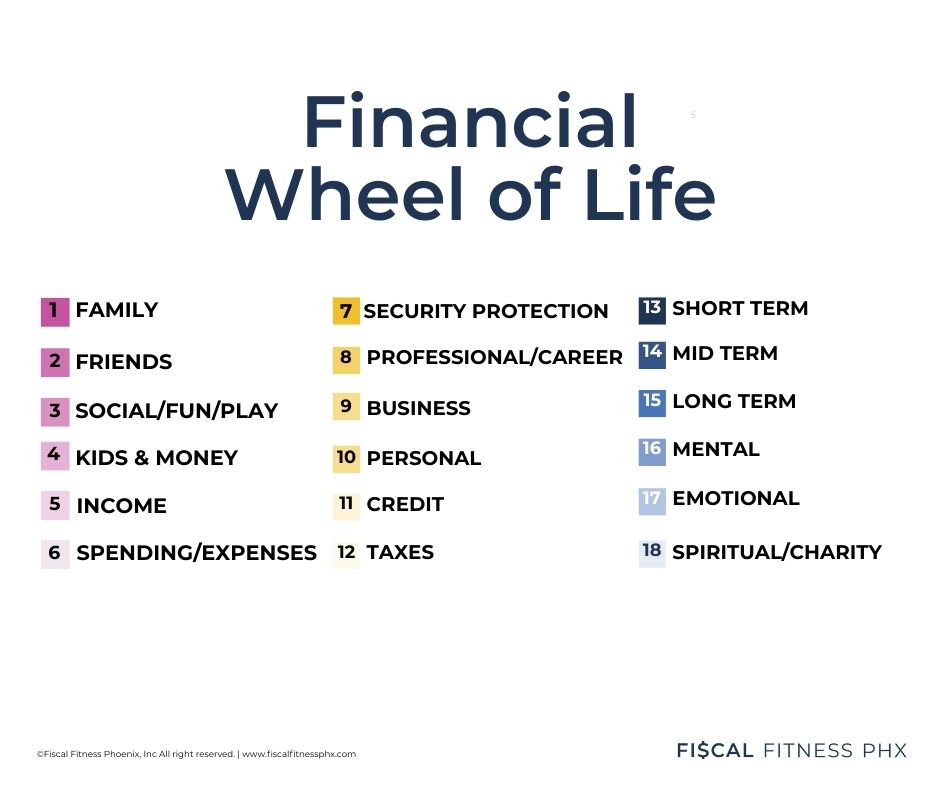
As you go through each category with your client, ask open-ended questions or give specific prompts based on what they’ve shared before. Focus on their current thoughts and feelings, not on solutions or improvements just yet.
Using the Wheel to Guide Your Coaching
Once you’ve gone through all the categories, look at where your client scored lowest. This could be the root cause of more obvious issues like spending problems or debt.
Ask your client, “What would make this just one point higher?” This helps you create a plan for making progress, one decision at a time and in one area at a time.
Resources for Coaches
Don’t forget to download the Financial Wheel of Life for use in your own coaching – just remember to give credit where it’s due. And if you’re looking for more help in specific areas, check out our specialty toolkit. These toolkits give you coaching concepts to use during sessions, helping you address various financial topics with confidence.